

Pelvic Health Physiotherapy
Assessment and treatment of the pelvic floor — leaking, urgency, prolapse, pelvic pain and the back or hip pain that travels with them.
Pelvic health physiotherapy is the assessment and treatment of the pelvic floor and everything that works with it — the muscles, connective tissue, nerves and joints at the base of the pelvis. It is carried out by a registered physiotherapist with additional training in the area. For an educated patient the useful thing to understand up front is this: the pelvic floor rarely fails in only one way, so good care starts with working out what is actually happening before deciding what to do about it. This page explains how the region works, why problems develop, what we look at in an assessment, and how treatment is built around the findings.
Your pelvic floor: a working overview
The pelvic floor is a layered sling of muscle and connective tissue that spans the base of the pelvis, anchoring from the pubic bone at the front to the tailbone at the back and out to the sitting bones on each side. It wraps around the openings of the urethra, vagina (in women) and anus, which is how it lets you hold on and release on purpose. Far from being a single muscle, it has superficial and deep layers that do several jobs at once:
- Support — it holds the bladder, bowel and, in women, the uterus in position against gravity and downward pressure.
- Continence — it keeps the outlets closed when you cough, laugh, lift or run, and relaxes when it is time to empty.
- Core stability — it works as the floor of a ‘canister’ with the breathing diaphragm above and the deep abdominal and back muscles around the sides, together managing the pressure inside your abdomen every time you move.
- Sexual function — muscle tone and comfort here contribute to sensation and to pain-free intimacy.
- Circulation — the rhythmic action of these muscles helps move blood and lymph through the pelvis.
Because the pelvic floor has to both contract and fully relax, and coordinate with your breath, a problem can be one of strength, of tension, of timing, or of all three — which is exactly why the same symptom can have very different causes.
Why pelvic floor problems develop
Symptoms in this region are usually multi-factorial. Understanding the common mechanisms explains why an individual assessment matters more than a generic set of exercises.
- Not simply ‘weak’. A pelvic floor can be underactive (low tone, poor strength), overactive (too tight, unable to relax and lengthen), or poorly coordinated. Weakness and over-tension can produce overlapping symptoms — leaking, urgency, pain — and strengthening an already-tight muscle usually makes things worse, so the direction of treatment depends on what the assessment finds.
- Pressure and load. Chronic constipation and straining, a persistent cough, or heavy lifting and high-impact activity without the pelvic floor conditioning to match all raise the downward force the floor has to manage.
- Pregnancy, birth and hormones. Pregnancy loads the pelvic floor for months; birth can stretch or scar it. Later, the fall in estrogen through perimenopause and menopause thins and loosens the supportive tissues, so symptoms can appear or return.
- Connective tissue and fascia. The fascia surrounding the pelvis lets muscles glide and share load; when it becomes restricted or sensitive, movement and comfort change even when the muscles themselves are reasonably strong.
- Nerve involvement. Nerves that supply the pelvis — the pudendal nerve among them — can become irritated, restricted or over-sensitive, contributing to pain, altered sensation, or urgency.
- The joints and the wider system. The sacroiliac joints, lower back, hips and tailbone share load and nerve supply with the pelvic floor, so trouble travels between them — which is why pelvic, back and hip symptoms so often appear together.
- Persistent pain and the nervous system. When pain continues for months, the nervous system can become more sensitive and amplify signals, so the experience of pain is no longer a simple readout of tissue damage. Care in that situation includes settling that sensitivity, not just training muscle.
Concerns pelvic floor physiotherapy can help with
People are often surprised by how many different concerns trace back to the pelvic floor. Common reasons to be assessed include:
- Bladder — leaking with effort (cough, sneeze, lift, run), sudden urgency and frequency (overactive bladder), waking at night, or a sense of not emptying fully.
- Bowel — constipation and straining, a feeling of incomplete emptying, or difficulty controlling wind or stool.
- Support — a feeling of heaviness, dragging or a bulge, which can point to pelvic organ prolapse; where suitable, a pessary can add non-surgical support.
- Pelvic and sexual pain — ongoing pelvic pain, pain with intercourse or examinations, difficulty with insertion, bladder pain, and tailbone or persistent groin pain.
- Pregnancy and recovery — comfort and preparation during pregnancy, and postpartum recovery including core rebuilding, scar care and diastasis.
- Life-stage change — bladder, pelvic and comfort changes around menopause.
- Men and children — men’s pelvic pain and post-surgical recovery, and children’s bladder and bowel concerns such as daytime leaking, bedwetting and constipation.
What a thorough assessment looks like
A first visit is mostly a detailed conversation. Your physiotherapist asks about your symptoms and how long they have been present, your bladder and bowel habits (a short diary can help), your pregnancy, surgical and medical history, any pain, your activity, and what you would like to get back to. From there they look at how you move, breathe and use your core, and screen the low back, hips, sacroiliac joints and posture, because the pelvic floor never works in isolation.
An external assessment comes first. An internal (vaginal or rectal) examination is the most accurate way to assess the muscles directly — resting tone, strength, endurance, coordination, the ability to relax and lengthen, tissue sensitivity and any tender points. It is always optional, explained fully beforehand, and only carried out with your informed consent; a great deal can be assessed and treated externally, and you set the pace throughout. The setting is private and unhurried.
How treatment works
Your plan is built around what the assessment finds rather than a standard recipe, and it is grounded in current evidence — supervised pelvic floor muscle training is recommended as a first-line option for several bladder and support conditions in international clinical guidelines. Depending on your needs it may include:
- Education and self-management — understanding your own findings, and practical changes to bladder, bowel, fluid and toileting habits that reduce urgency and straining.
- Retraining the pelvic floor — strengthening where it is underactive, down-training and release where it is overactive, and improving the coordination and timing that let it brace and let go at the right moments.
- Hands-on therapy — manual techniques for tight or sensitive muscles, trigger-point release, and connective-tissue and scar work where indicated.
- Breathing and pressure management — strategies for lifting, exercise and daily tasks so you are not repeatedly straining down onto the floor.
- Bladder and bowel retraining — urge-calming techniques and defecation mechanics for the concerns that habits, not just muscle, are driving.
- A graded return to activity — a step-by-step path back to running, lifting and impact, plus a home program you can realistically keep up. Real-time feedback (biofeedback) is used where it helps you learn a movement.
Most people notice meaningful change over a course of visits, though the right timeline depends on the individual and the concern. Progress is measured by how you feel and function — comfort, confidence and getting back to what you enjoy — rather than by a fixed schedule.
Is pelvic floor physiotherapy right for you?
There is no threshold you have to reach first. If symptoms are limiting what you do, changing what you wear, or simply bothering you, that is reason enough to be assessed. In Ontario you can book directly, without a referral. It is not a women’s-only service, and while earlier is often easier, these concerns respond to treatment at many stages of life. At SOMOM in High Park, Toronto, every part of the assessment and treatment is explained first, carried out with your consent, and always at your pace.
Conditions We Treat
Pelvic health physiotherapy helps across bladder, bowel, sexual, and pelvic-pain health — for women, at every stage of life. These are the conditions we see most often; if what you're experiencing isn't listed, reach out and we'll talk it through first.
Urinary Incontinence
Leaking with a cough, sneeze, laugh, or workout (stress incontinence), or a sudden urge that's hard to hold (urge incontinence) — a common concern that pelvic floor physiotherapy addresses directly.
Pelvic Organ Prolapse
A feeling of heaviness, pressure, or a bulge as the bladder, uterus, or rectum loses some of its usual support — eased with guided pelvic floor work and, where it helps, a pessary.
Vaginismus & Penetration Difficulty
Involuntary tightening of the pelvic floor that makes penetration — tampons, intimacy, or an exam — painful or difficult; it responds well to gentle, graded physiotherapy.
Pregnancy & Postpartum Concerns
Pelvic-girdle and back pain, leaking, heaviness, core separation (diastasis recti), or a slow recovery through pregnancy and after birth — vaginal or c-section, recent or years ago.
Bowel Dysfunction
Constipation and straining, incomplete emptying, or trouble controlling gas or stool — often tied to how the pelvic floor coordinates.
Painful Intercourse (Dyspareunia)
Pain with penetration, deeper pain, or discomfort afterward — assessed gently and privately to find what's driving it.
Sexual Dysfunction
Changes in comfort, arousal, sensation, or orgasm connected to pelvic floor tension or weakness — after birth, surgery, or with menopause.
Endometriosis
Cyclical or ongoing pelvic pain related to endometriosis, supported with pelvic floor physiotherapy that works alongside the rest of your medical team.
Menopause-Related Symptoms
Bladder leaks, urgency, dryness, prolapse, or discomfort as hormones shift through perimenopause and beyond — treatable rather than inevitable.
Vulvodynia
Ongoing burning, stinging, or rawness of the vulva, with or without touch and without a clear infection — often eased by settling an overactive pelvic floor.
Vestibulodynia
Sharp pain or burning at the vaginal opening (the vestibule), frequently triggered by touch, tampons, or intimacy.
Interstitial Cystitis (Bladder Pain Syndrome)
Bladder pressure, pain, and urinary frequency in the absence of infection — physiotherapy helps calm the pelvic floor and bladder symptoms, alongside your physician.
Pudendal Neuralgia
Nerve-related pain, burning, or numbness through the pelvis, sit bones, or genitals — often worse with prolonged sitting.
Coccydynia (Tailbone Pain)
Persistent pain at the tailbone, usually worse when sitting or rising from a seat — common after a fall, childbirth, or long hours seated.
Levator Ani Syndrome
Aching, pressure, or spasm felt deep in the pelvic floor or rectum from chronically tight levator ani muscles.
Vulvar Skin Conditions
Support for the pelvic floor tension and discomfort that can accompany vulvar skin conditions, working alongside your dermatologist or physician.
Chronic Pelvic Pain Syndrome
Pelvic pain lasting three months or more without a clear medical cause — often driven by a guarding, overactive pelvic floor that responds to release-focused physiotherapy.
Clitorodynia & PGAD
Pain at the clitoris, or persistent unwanted arousal (persistent genital arousal disorder), linked to pelvic floor and nerve irritation — assessed sensitively, at your pace.
How This Helps at Every Stage
Fertility & Preconception
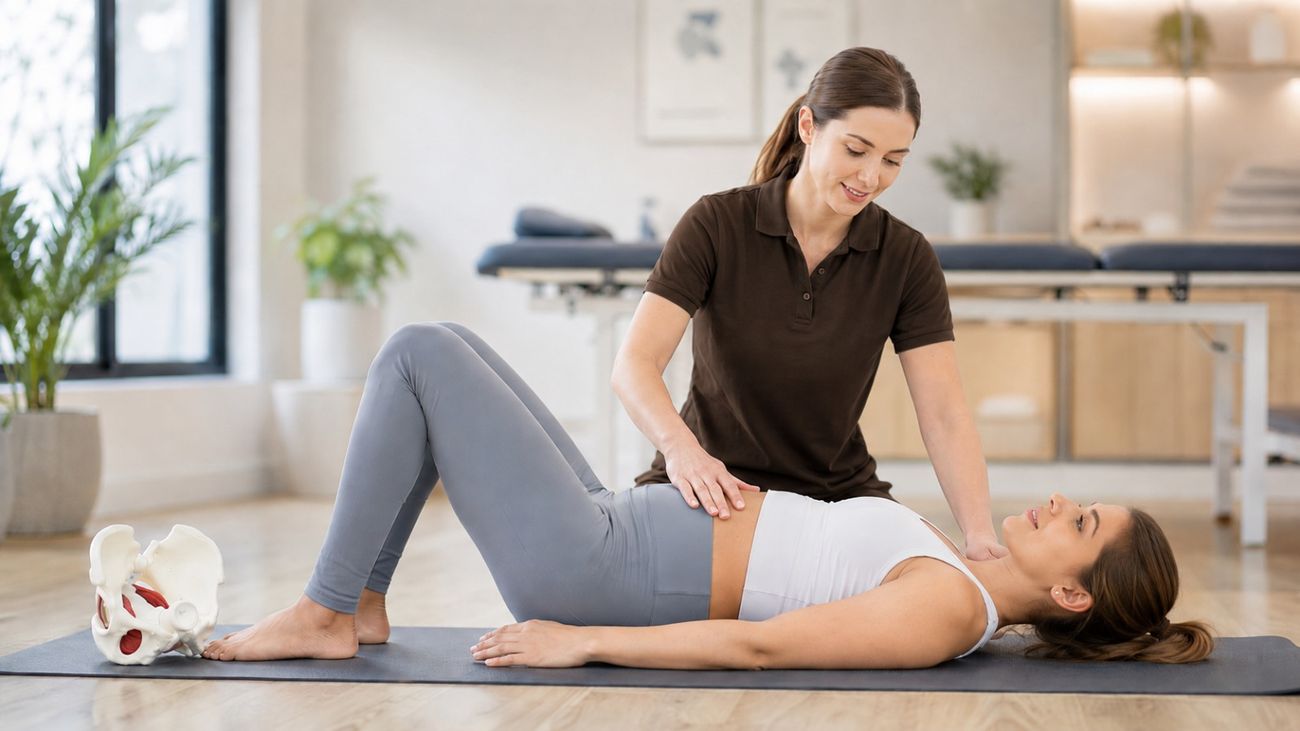
Many people don't realize pelvic floor physiotherapy is useful before you even start trying to conceive. A tense, uncoordinated pelvic floor can restrict blood flow to the reproductive organs and add unnecessary tension through the pelvis — addressing that ahead of time, rather than after a diagnosis, gives your body the most time to respond. It's also the easiest window to treat restrictions from past surgery, endometriosis, or scar tissue, before pregnancy adds another layer of change on top.

During Pregnancy
As your uterus grows, it changes how your pelvic floor is loaded, while the hormone relaxin loosens connective tissue throughout your pelvis and spine to prepare for birth — a combination that commonly shows up as pelvic girdle pain or low back pain long before delivery. Physiotherapy through pregnancy manages that pain trimester by trimester, and also prepares the pelvic floor itself for labour: teaching it to release and coordinate, not just tighten, so pushing works with your body instead of against it.

Postpartum Recovery
Whatever kind of delivery you had, the postpartum period is when the changes of pregnancy and birth actually get treated, rather than just monitored at a single six-week checkup — diastasis recti, incontinence, scar mobility, and pelvic pain are all addressable, and it is never too late to start, whether your baby is six weeks or six years old. A C-section doesn't mean you skip this stage either: nine months of pregnancy still loads the pelvic floor, and a C-section is still major abdominal surgery your core has to recover from.
Perimenopause & Menopause
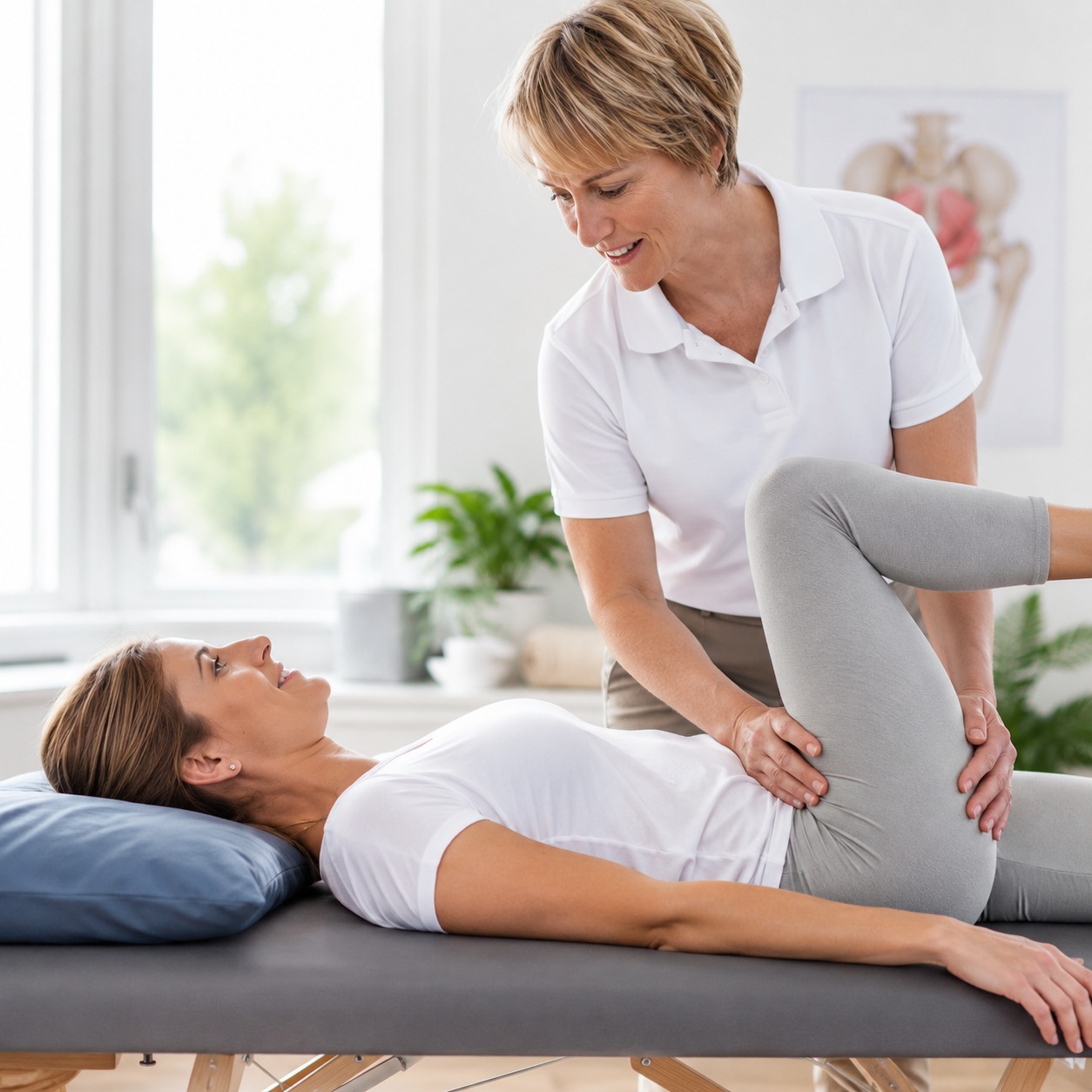
Declining estrogen thins and reduces the elasticity of pelvic tissue, which is why bladder leakage, prolapse symptoms, or pain can appear for the first time in your 40s or 50s, or return after years of feeling fine. It's easy to dismiss this as "just aging," but the muscles themselves respond to the same physiotherapy approach as at any other stage, often alongside options like pessary fitting for extra support.
Ready to start your pelvic health physiotherapy?
What to Expect
Your first visit is 60 minutes and led by conversation — your symptoms and history, your bladder and bowel habits, any pain, and what you want to get back to. Bringing a few days of a simple bladder or bowel diary can make the picture clearer, but it is not essential.
The physical part happens at your pace and with your agreement at each step. Your physiotherapist looks at how your breathing, core and pelvic floor work together and screens the related joints and posture. An external assessment comes first; an internal (vaginal or rectal) examination is offered because it is the most accurate way to assess the muscles directly, but it is entirely optional and only done with your informed consent — many concerns can be assessed and treated externally.
You leave the first visit with an explanation of what was found and a starting plan — usually a small number of exercises or strategies to begin with — not a fixed template. After birth, an assessment is commonly done around six weeks postpartum or after your first check with your OB, midwife or family doctor, and sooner if you are in significant pain. The setting is private and confidential throughout.
Frequently Asked Questions
Do I need a doctor's referral to book?
No referral is required — you can book directly online or by phone.
Is pelvic health physiotherapy covered by insurance?
Most extended health plans include physiotherapy coverage, though the amount and any conditions vary from plan to plan. We provide direct billing for most insurance providers, and our team is glad to help you check your coverage before your first visit.
How many sessions will I need?
This varies from person to person, but most people begin to notice meaningful changes within about 6 to 8 sessions. Some concerns ease sooner, while longer-standing or more complex issues can take a little more time. After your initial assessment your physiotherapist will recommend a plan tailored to your symptoms and goals, and adjust it as you progress and your body responds.
What should I wear to my appointment?
Comfortable, loose-fitting clothing that allows easy movement is best.
Explore by Life Stage

Fertility Care
Physiotherapy support in the months before pregnancy — pelvic floor function, core, mobility and movement, alongside your medical fertility care.
Explore fertility care
Prenatal Care
Physiotherapy through pregnancy — pelvic girdle and back pain, pelvic floor preparation, and staying active safely, alongside your maternity care.
Explore prenatal care
Postpartum Care
Rebuilding after birth — pelvic floor and core recovery, scar and back pain, and a graded return to exercise, at your own pace.
Explore postpartum care
Menopause Management
Physiotherapy for the pelvic-floor changes of perimenopause and menopause — bladder urgency and leakage, prolapse, and vaginal or pelvic discomfort — alongside your medical care.
Explore menopause management
Orthopedic Physiotherapy
Assessment and treatment for joint, muscle and post-surgical concerns — back, neck, shoulder, hip and knee.
Explore orthopedic physiotherapy
Diastasis Recti (Mommy Tummy)
Assessment and progressive rehabilitation for abdominal separation after pregnancy — the gap, and the strength around it.
Explore diastasis recti (mommy tummy)
TMJ Physiotherapy
Physiotherapy for jaw pain, clicking, limited opening and related headaches — assessing the jaw, neck and posture together.
Explore tmj physiotherapyStill have questions? Let Leo help.
Answer a few quick questions and I’ll point you to the best next step.
Leo · your guide